Tips to Remember Multiplication Tables
Times table of 2
Add the number to itself. Or, skip 1 number each time and count the next.
2 × 1 = 2 2 × 2 = 4 2 × 3 = 6 2 × 4 = 8 2 × 5 = 10 2 × 6 = 12 2 × 7 = 14 2 × 8 = 16 2 × 9 = 18 2 × 10 = 20 2 × 11 = 22 2 × 12 = 24
Examples:
2 × 2 = 2 + 2 = 4 2 × 5 = 5 + 5 = 10 2 × 11 = 11 + 11 = 22
Times table of 3
Double the number and add it again one more time.
3 × 1 = 3 3 × 2 = 6 3 × 3 = 9 3 × 4 = 12 3 × 5 = 15 3 × 6 = 18 3 × 7 = 21 3 × 8 = 24 3 × 9 = 27 3 × 10 = 30 3 × 11 = 33 3 × 12 = 36
Examples:
3 × 2 = (2 + 2) + 2 = 6 3 × 6 = (6 + 6) + 6 = 18 3 × 12 = (12 + 12) + 12 = 36
Times table of 4
Double the number and then double the result to get the answer.
4 × 1 = 4 4 × 2 = 8 4 × 3 = 12 4 × 4 = 16 4 × 5 = 20 4 × 6 = 24 4 × 7 = 28 4 × 8 = 32 4 × 9 = 36 4 × 10 = 40 4 × 11 = 44 4 × 12 = 48
Examples:
4 × 3
- Step 1:
3 + 3 = 6
- Step 2:
6 + 6 = 12 So, 4 × 3 = 12
4 × 8
- Step 1:
8 + 8 = 16
- Step 2:
16 + 16 = 32 So, 4 × 8 = 32
4 × 12
- Step 1:
12 + 12 = 24
- Step 2:
24 + 24 = 48 So, 4 × 12 = 48
Times table of 5
5× is the half of 10×. So, do 10× first, and then halve the result to get the answer.
5 × 1 = 5 5 × 2 = 10 5 × 3 = 15 5 × 4 = 20 5 × 5 = 25 5 × 6 = 30 5 × 7 = 35 5 × 8 = 40 5 × 9 = 45 5 × 10 = 50 5 × 11 = 55 5 × 12 = 60
Notes:
5 × odd number gives 5 in the ones place.
5 × even number gives 0 in the ones place.
Examples:
5 × 4
- Step 1:
10 × 4 = 40
- Step 2:
40 ÷ 2 = 20 So, 5 × 4 = 20
5 × 7
- Step 1:
10 × 7 = 70
- Step 2:
70 ÷ 2 = 35 So, 5 × 7 = 35
5 × 12
- Step 1:
10 × 12 = 120
- Step 2:
120 ÷ 2 = 60 So, 5 × 12 = 60
Times table of 6
METHOD 1:
6 × 1 = 6 6 × 2 = 12 6 × 3 = 18 6 × 4 = 24 6 × 5 = 30 6 × 6 = 36 6 × 7 = 42 6 × 8 = 48 6 × 9 = 54 6 × 10 = 60 6 × 11 = 66 6 × 12 = 72
- For 6× an even number (2, 4, 6 or 8 (NOT 10 and 12))
- The digit in the ones place will be the same as that even number.
- The digit in the tens place will be half of that even number.
So,
6 × 2 = 12 6 × 4 = 24 6 × 6 = 36 6 × 8 = 48
- For 6× an odd number (3, 5, 7, 9 or 11),
- Go to the even number just before it and multiply it by 6.
- Then, add 6 to the result to get the answer.
So,
6 × 3 = (6 × 2) + 6 = 12 + 6 = 18 6 × 5 = (6 × 4) + 6 = 24 + 6 = 30 6 × 7 = (6 × 6) + 6 = 36 + 6 = 42 6 × 9 = (6 × 8) + 6 = 48 + 6 = 54 6 × 11 = (6 × 10) + 6 = 60 + 6 = 66
METHOD 2:
6 is the double of 3. So, first do 3× and then double the result to get the answer.
Examples:
6 × 4
- Step 1:
3 × 4 = 12
- Step 2:
12 + 12 = 24 So, 6 × 4 = 24
6 × 8
- Step 1:
3 × 8 = 24
- Step 2:
24 + 24 = 48 So, 6 × 8 = 48
6 × 12
- Step 1:
3 × 12 = 36
- Step 2:
36 + 36 = 72 So, 6 × 12 = 72
Times table of 7
7× is slightly tricky but not that bad!! So, here we go...
7 × 1 = 7 7 × 2 = 14 7 × 3 = 21 7 × 4 = 28 7 × 5 = 35 7 × 6 = 42 7 × 7 = 49 7 × 8 = 56 7 × 9 = 63 7 × 10 = 70 7 × 11 = 77 7 × 12 = 84
- For 2 to 5, switch the numbers.
7 × 2 = 2 × 7 = 14
7 × 3 = 3 × 7 = 21
7 × 4 = 4 × 7 = 28
7 × 5 = 5 × 7 = 35
- After that, use 7 × 5 = 35 or 7 × 10 = 70 to get the rest.
7 × 6 = 35 + 7 = 42 7 × 7 = 35 + 7 + 7 = 49 7 × 8 = 35 + 7 + 7 + 7 = 56 7 × 9 = 70 − 7 = 63 7 × 10 = 70 7 × 11 = 70 + 7 = 77 7 × 12 = 70 + 7 + 7 = 84
Times table of 8
METHOD 1:
8 × 1 = 8 8 × 2 = 16 8 × 3 = 24 8 × 4 = 32 8 × 5 = 40 8 × 6 = 48 8 × 7 = 56 8 × 8 = 64 8 × 9 = 72 8 × 10 = 80 8 × 11 = 88 8 × 12 = 96
8 is the double of 4. So, first do 4× and then double the result to get the answer.
Examples:
8 × 3
- Step 1:
4 × 3 = 12
- Step 2:
12 + 12 = 24 So, 8 × 3 = 24
8 × 7
- Step 1:
4 × 7 = 28
- Step 2:
28 + 28 = 56 So, 8 × 7 = 56
8 × 12
- Step 1:
4 × 12 = 48
- Step 2:
48 + 48 = 96 So, 8 × 12 = 96
METHOD 2:
8 = 10 − 2
So,
8× = 10× − 2×
Examples:
8 × 3
- Step 1:
10 × 3 = 30
- Step 2:
2 × 3 = 6
- Step 3:
30 − 6 = 24 So, 8 × 3 = 24
8 × 7
- Step 1:
10 × 7 = 70
- Step 2:
2 × 7 = 14
- Step 3:
70 − 14 = 56 So, 8 × 7 = 56
8 × 12
- Step 1:
10 × 12 = 120
- Step 2:
2 × 12 = 24
- Step 3:
120 − 24 = 96 So, 8 × 12 = 96
Times table of 9
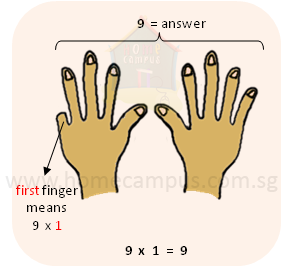
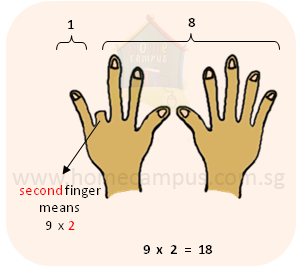
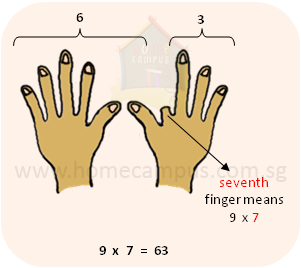
METHOD 1: Use the finger counting method.
9 × 1 = 9 9 × 2 = 18 9 × 3 = 27 9 × 4 = 36 9 × 5 = 45 9 × 6 = 54 9 × 7 = 63 9 × 8 = 72 9 × 9 = 81 9 × 10 = 90 9 × 11 = 99 9 × 12 = 108
Examples:
9 × 1
Bend your first finger and count as shown.
9 × 2
Bend your second finger and count as shown below.
9 × 7
Bend your seventh finger and count as shown below.
METHOD 2: Do 10× the number minus the number.
Examples:
9 × 2 = (10 × 2) − 2 = 20 − 2 = 18 9 × 7 = (10 × 7) − 7 = 70 − 7 = 63 9 × 12 = (10 × 12) − 12 = 120 − 12 = 108
Times table of 10
Take the number you are multiplying 10 by and put a zero after it.
10 × 1 = 10 10 × 2 = 20 10 × 3 = 30 10 × 4 = 40 10 × 5 = 50 10 × 6 = 60 10 × 7 = 70 10 × 8 = 80 10 × 9 = 90 10 × 10 = 100 10 × 11 = 110 10 × 12 = 120
Examples:
10 × 3 = 30 10 × 8 = 80 10 × 11 = 110
Times table of 11
11 × 1 = 11 11 × 2 = 22 11 × 3 = 33 11 × 4 = 44 11 × 5 = 55 11 × 6 = 66 11 × 7 = 77 11 × 8 = 88 11 × 9 = 99 11 × 10 = 110 11 × 11 = 121 11 × 12 = 132
- For ×1 to ×9, both the digits of the answer are the same as the number being multiplied by 11.
Examples:
11 × 4 = 44 11 × 7 = 77 11 × 9 = 99
- For ×10, ×11 and ×12,
11 × 10 = 110 11 × 11 = 110 + 11 = 121 11 × 12 = 110 + 11 + 11 = 132
Times table of 12
12 = 10 + 2
12 × 1 = 12 12 × 2 = 24 12 × 3 = 36 12 × 4 = 48 12 × 5 = 60 12 × 6 = 72 12 × 7 = 84 12 × 8 = 96 12 × 9 = 108 12 × 10 = 120 12 × 11 = 132 12 × 12 = 144
So,
12× = 10× + 2×
Examples:
12 × 3
- Step 1:
10 × 3 = 30
- Step 2:
2 × 3 = 6
- Step 3:
30 + 6 = 36 So, 12 × 3 = 36
12 × 7
- Step 1:
10 × 7 = 70
- Step 2:
2 × 7 = 14
- Step 3:
70 + 14 = 84 So, 12 × 7 = 84
12 × 12
- Step 1:
10 × 12 = 120
- Step 2:
2 × 12 = 24
- Step 3:
120 + 24 = 144 So, 12 × 12 = 144