Length Mass Volume: Real Life 1-Step Word Problems
In this video
How do I solve a 1-step word problem?
Read the problem and draw a bar model. Then choose what to do:
Add for a total, or to find the bigger amount when you know how much more it is.
Subtract for what is left, or for a difference (how much more, how much less).
Multiply for times as many.
Divide for equal pieces.
Make the units the same, and write a statement.
Add for a total, or to find the bigger amount when you know how much more it is.
Subtract for what is left, or for a difference (how much more, how much less).
Multiply for times as many.
Divide for equal pieces.
Make the units the same, and write a statement.
1. A dictionary has a mass of 1478 g.
A diary has a mass of 1872 g.
What is their total mass in kilograms and grams?
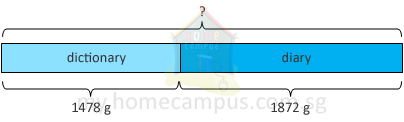
We want the whole bar, so we add the 2 parts.
1478 g + 1872 g
= 3350 g
= 3000 g + 350 g
= 3 kg + 350 g (1000 g = 1 kg)
= 3 kg 350 g
Their total mass is 3 kg 350 g.
1478 g + 1872 g
= 3350 g
= 3000 g + 350 g
= 3 kg + 350 g (1000 g = 1 kg)
= 3 kg 350 g
Their total mass is 3 kg 350 g.
2. Chelsea's house is 8 km from the theme park.
It is 5 times as far from the water park as the theme park.
Find the distance between Chelsea's house and the water park.
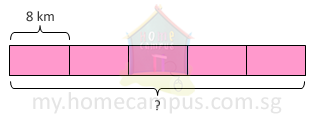
The theme park is 1 unit, 8 km. The water park is 5 times as far: 5 units. We want all 5 units, so we multiply.
8 km × 5 = 40 km
The distance between Chelsea's house and the water park is 40 km.
8 km × 5 = 40 km
The distance between Chelsea's house and the water park is 40 km.
3. A sack of wheat has a mass of 31 kg.
A sack of corn has a mass of 18 kg.
How much heavier is the sack of wheat than the sack of corn?
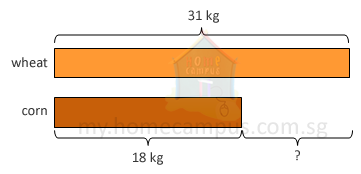
We want the difference between the 2 bars, so we subtract.
31 kg − 18 kg = 13 kg
The sack of wheat is 13 kg heavier than the sack of corn.
31 kg − 18 kg = 13 kg
The sack of wheat is 13 kg heavier than the sack of corn.
4. Olivia has a plastic wrap of length 305 cm.
She cuts it into 5 pieces.
What is the length of each piece?
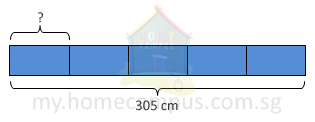
Cut the whole 305 cm into 5 equal pieces. We want 1 piece. Sharing into equal pieces, we divide.
305 cm ÷ 5 = 61 cm
The length of each piece is 61 cm.
305 cm ÷ 5 = 61 cm
The length of each piece is 61 cm.
5. Jeff had 218 ml of glycerine.
He had 71 ml less glycerine than Mia.
How much glycerine had Mia?
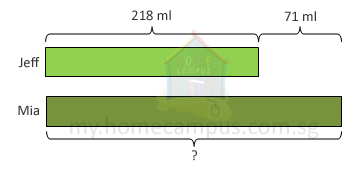
Jeff had 71 ml less than Mia, so Mia had more. Mia's bar is longer than Jeff's by 71 ml, so we add.
218 ml + 71 ml = 289 ml
Mia had 289 ml of glycerine.
Watch out: the word "less" does not always mean subtract. 218 ml − 71 ml = 147 ml is wrong, because Jeff had less, so Mia had more than 218 ml.
218 ml + 71 ml = 289 ml
Mia had 289 ml of glycerine.
Watch out: the word "less" does not always mean subtract. 218 ml − 71 ml = 147 ml is wrong, because Jeff had less, so Mia had more than 218 ml.
6. Taylor had 1000 g of brown rice.
He packed the brown rice into bags of 200 g each.
How many bags did he make?
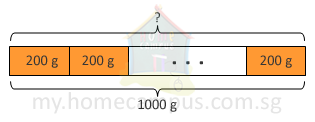
Each bag has the same mass, 200 g. To find how many equal bags, we divide.
1000 g ÷ 200 g = 5
He made 5 bags.
1000 g ÷ 200 g = 5
He made 5 bags.
1000 ÷ 200 can be thought of as 10 ÷ 2.
7. Halle bought 4 m of gift wrapper.
She used 165 cm of it to wrap a gift.
What is the length of gift wrapper she had left?
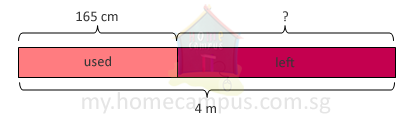
We want what is left, so we subtract. Make the units the same first: 1 m = 100 cm, so 4 m = 400 cm.
4 m − 165 cm
= 400 cm − 165 cm
= 235 cm
= 200 cm + 35 cm
= 2 m + 35 cm
= 2 m 35 cm
She had 2 m 35 cm of gift wrapper left.
4 m − 165 cm
= 400 cm − 165 cm
= 235 cm
= 200 cm + 35 cm
= 2 m + 35 cm
= 2 m 35 cm
She had 2 m 35 cm of gift wrapper left.
8. A dispenser has a capacity of 3 l.
How many more millilitres of fruit punch are needed to fill the dispenser to the brim
if the dispenser contains 340 ml of fruit punch?

The full dispenser, 3 l, is the whole bar. We want the rest, so we subtract. Change 3 l into millilitres first: 1 l = 1000 ml, so 3 l = 3000 ml.
3 l − 340 ml
= 3000 ml − 340 ml
= 2660 ml
2660 ml of fruit punch is needed to fill the dispenser to the brim.
3 l − 340 ml
= 3000 ml − 340 ml
= 2660 ml
2660 ml of fruit punch is needed to fill the dispenser to the brim.