Multiplication and Division
Primary 4 (Grade 4)
In this video
1. Find the product of 1653 and 4. (Multiplying by a 1-digit Number)
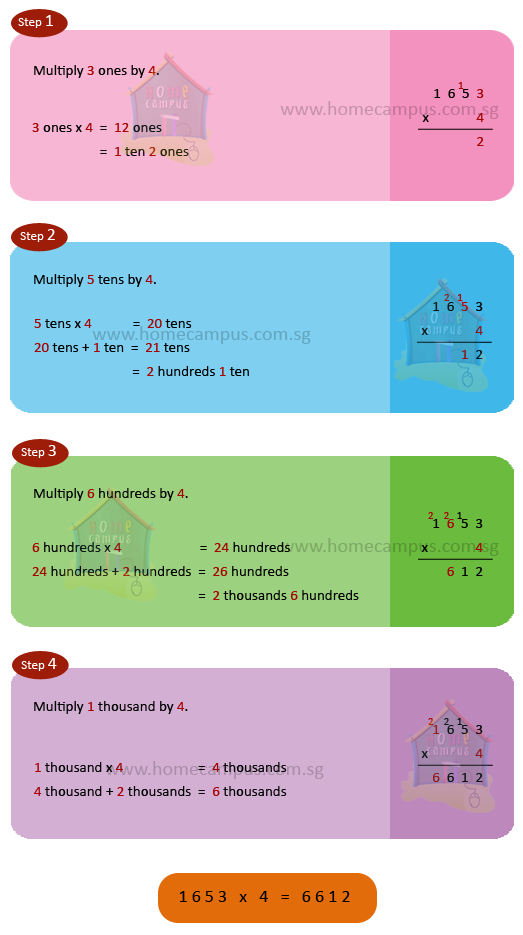
Ones: 4 × 3 = 12 ones, which is 1 ten and 2 ones. Write 2 and regroup the 1 ten.
Tens: 5 tens × 4 = 20 tens, plus the 1 ten is 21 tens, which is 2 hundreds and 1 ten. Write 1 and regroup 2.
Hundreds: 6 × 4 = 24, plus 2 is 26. Write 6 and regroup 2.
Thousands: 1 × 4 = 4, plus 2 is 6.
1653 × 4 = 6612
2. Multiply 394 by 8.
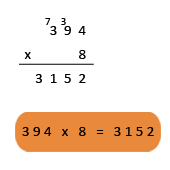
4 × 8 = 32. Write 2 and regroup 3.
9 × 8 = 72, plus 3 is 75. Write 5 and regroup 7.
3 × 8 = 24, plus 7 is 31.
394 × 8 = 3152
3. Multiply 482 by 57. (Multiplying by a 2-digit Number)
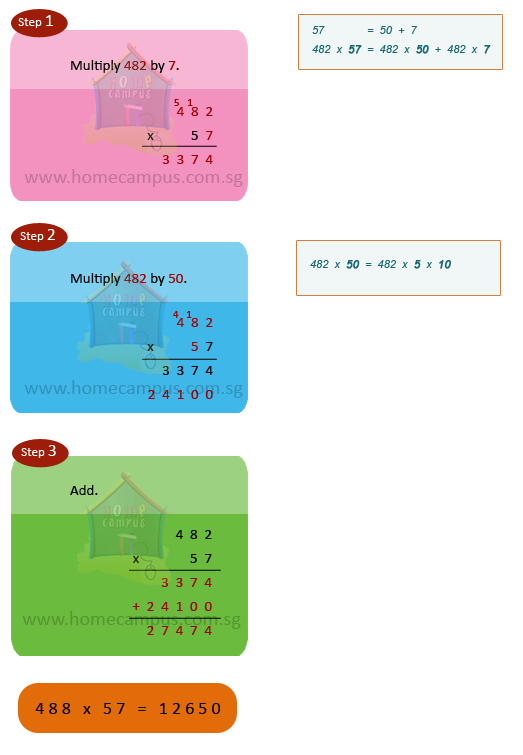
Multiply by the ones, then by the tens, then add the two rows.
First, 482 × 7: 2 × 7 = 14, write 4 and regroup 1. 8 × 7 = 56, plus 1 is 57, write 7 and regroup 5. 4 × 7 = 28, plus 5 is 33. So 482 × 7 = 3374.
Next, 482 × 50. 50 is 5 tens, so write 0 in the ones place first. 2 × 5 = 10, write 0 and regroup 1. 8 × 5 = 40, plus 1 is 41, write 1 and regroup 4. 4 × 5 = 20, plus 4 is 24. So 482 × 50 = 24 100.
Then add the two rows: 3374 + 24 100 = 27 474.
482 × 57 = 27 474
Watch out: Many children get 5784 because they forget the 0 in the ones place of the second row. When you multiply by the tens digit, write 0 first.
4. Find the product of 655 and 28.
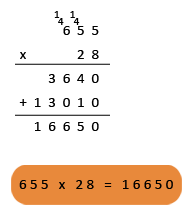
655 × 8 = 5240.
655 × 20: write 0 first, then multiply by 2. 655 × 20 = 13 100.
Add the two rows: 5240 + 13 100 = 18 340.
655 × 28 = 18 340
5. Divide 8464 ÷ 4. (Dividing by a 1-digit Number)
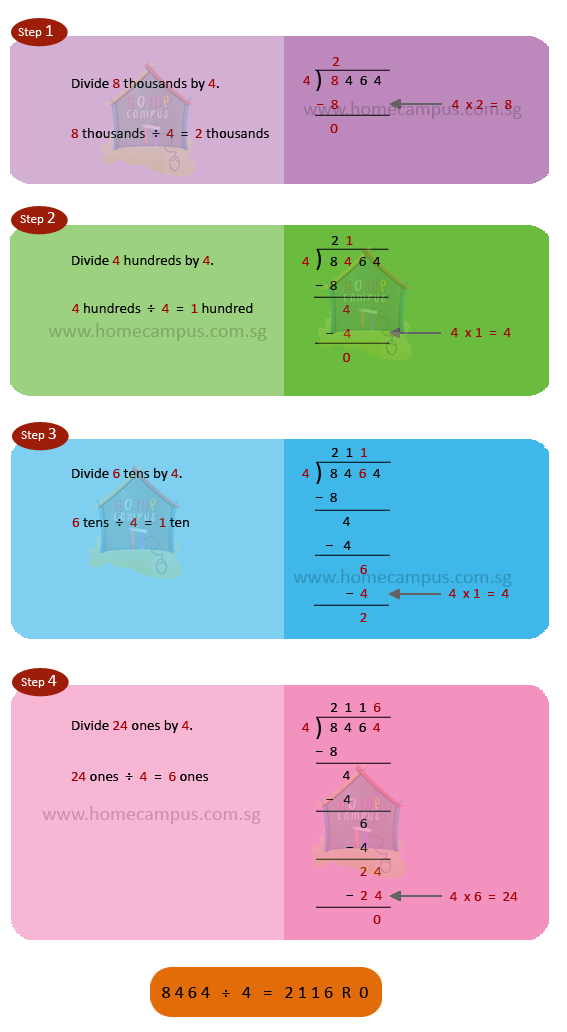
Divide from the greatest place.
8 thousands ÷ 4 = 2 thousands, nothing left. Bring down the 4.
4 hundreds ÷ 4 = 1 hundred. Bring down the 6.
6 tens ÷ 4 = 1 ten, and 2 tens are left. 2 tens are 20 ones, and with the 4 that makes 24 ones.
24 ÷ 4 = 6, and nothing is left.
8464 ÷ 4 = 2116
6. A baker packed 118 cookies into each tin.
a. How many cookies are there in 4 such tins?
b. How many cookies are there in 24 such tins?
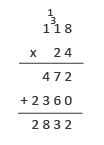
a. 1 tin = 118 cookies
4 tins = 118 × 4
= 472
There are 472 cookies in 4 tins.
(8 × 4 = 32, write 2 and regroup 3. 1 × 4 = 4, plus 3 is 7. Then 4.)
4 tins = 118 × 4
= 472
There are 472 cookies in 4 tins.
(8 × 4 = 32, write 2 and regroup 3. 1 × 4 = 4, plus 3 is 7. Then 4.)

b. 1 tin = 118 cookies
24 tins = 118 × 24
= 2832
There are 2832 cookies in 24 tins.
(118 × 4 = 472, as in part a. 118 × 20: write 0 first, then 118 × 2 = 236, so 2360. Add: 472 + 2360 = 2832.)
24 tins = 118 × 24
= 2832
There are 2832 cookies in 24 tins.
(118 × 4 = 472, as in part a. 118 × 20: write 0 first, then 118 × 2 = 236, so 2360. Add: 472 + 2360 = 2832.)
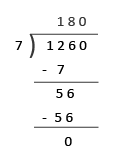
7. Mala divided 1260 beads equally to make 7 necklaces. How many beads did she use for each necklace?
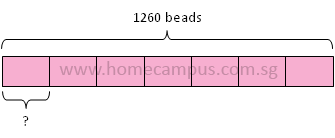
7 equal units make 1260 beads. To find 1 unit, divide by 7.
1 thousand cannot be shared among 7, so take 12 hundreds. 12 hundreds ÷ 7 = 1 hundred, and 5 hundreds are left. Bring down the 6 to make 56 tens. 56 ÷ 7 = 8. Bring down the 0. 0 ÷ 7 = 0.
1260 ÷ 7 = 180
She used 180 beads for each necklace.
1 thousand cannot be shared among 7, so take 12 hundreds. 12 hundreds ÷ 7 = 1 hundred, and 5 hundreds are left. Bring down the 6 to make 56 tens. 56 ÷ 7 = 8. Bring down the 0. 0 ÷ 7 = 0.
1260 ÷ 7 = 180
She used 180 beads for each necklace.