Adding Like and Unlike Fractions
Primary 5 (Grade 5)
In this video
What are like fractions?
Fractions with same denominators are called like fractions. Example:
and
. Both pizzas are cut into 4 equal slices, so every slice is the same size.
| 1 |
| 4 |
| 3 |
| 4 |
What are unlike fractions?
Fractions with different denominators are called unlike fractions. Example:
and
. A half is bigger than a third, so the slices are not the same size.
| 1 |
| 2 |
| 1 |
| 3 |
How to add like fractions?
Step 1: Add all the numerators. (Denominator will remain the same, because the slices are still the same size.)
Step 2: Simplify if required.
See the example below
How to add unlike fractions?
Step 1: Change unlike fractions to like fractions. i.e. find a common denominator. We can only add slices of the same size.
Step 2: Add all the numerators.
Step 3: Simplify if required.
See the example below
1. The lesson video at the top of this page shows how to add proper fractions.
A proper fraction is a fraction in which the numerator is smaller than the denominator. Each one is less than 1 whole.
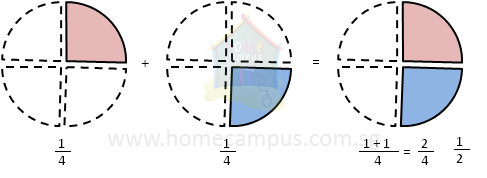
2. Jen and Fred each had
| 1 |
| 4 |
What fraction of the pie did they have together?
Jen =>
Fred =>
Jen + Fred =>
+
+
=
=
=
(simplify)
=
Jen and Fred had
a pie together.
| 1 |
| 4 |
Fred =>
| 1 |
| 4 |
Jen + Fred =>
| 1 |
| 4 |
| 1 |
| 4 |
| 1 |
| 4 |
| 1 |
| 4 |
=
| 1 + 1 |
| 4 |
=
| 2 |
| 4 |
=
| 2 / 2 |
| 4 / 2 |
=
| 1 |
| 2 |
Jen and Fred had
| 1 |
| 2 |
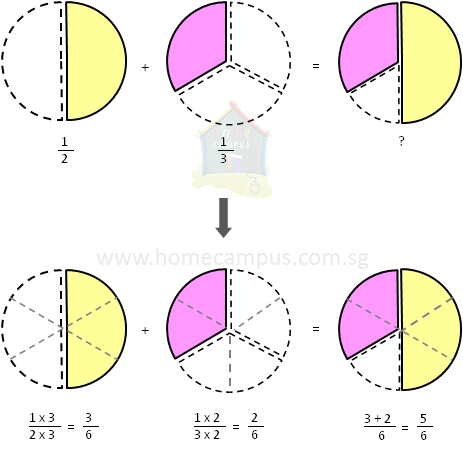
3. Charlie gives
| 1 |
| 2 |
| 1 |
| 3 |
How much of the pizza does Charlie give to Alfred and Beatrice together?
Alfred =>
Beatrice =>
Alfred + Beatrice =>
+
| 1 |
| 2 |
Beatrice =>
| 1 |
| 3 |
Alfred + Beatrice =>
| 1 |
| 2 |
| 1 |
| 3 |
| 1 |
| 2 |
| 1 |
| 3 |
=
| 1 x 3 |
| 2 x 3 |
| 1 x 2 |
| 3 x 2 |
=
| 3 |
| 6 |
| 2 |
| 6 |
=
| 5 |
| 6 |
5 and 6 have no common factor except 1, so
| 5 |
| 6 |
Charlie gives
| 5 |
| 6 |
Since the two fractions,
and
, are unlike fractions (as the denominators are different), we must first change them to like fractions before we can add them (that is, find a common denominator).
| 1 |
| 2 |
| 1 |
| 3 |
In other words, at first, the pizzas are cut into different number of slices. To add them, we must cut them into same number of slices. 2 × 3 = 6, so cut every pizza into sixths.
Watch out: we can only add slices of the same size, so we cannot just count the slices of
and
. Do not add the denominators:
+
is not
. Change both to the same size slices first.
Watch out: we can only add slices of the same size, so we cannot just count the slices of
| 1 |
| 2 |
| 1 |
| 3 |
| 1 |
| 2 |
| 1 |
| 3 |
| 2 |
| 5 |
4. Your turn: add
| 1 |
| 4 |
| 1 |
| 3 |
The denominators are 4 and 3, so these are unlike fractions. 4 × 3 = 12, so the common denominator is 12.
+
=
+
=
+
=
7 and 12 have no common factor except 1, so
is already in its simplest form.
| 1 |
| 4 |
| 1 |
| 3 |
=
| 1 x 3 |
| 4 x 3 |
| 1 x 4 |
| 3 x 4 |
=
| 3 |
| 12 |
| 4 |
| 12 |
=
| 7 |
| 12 |
7 and 12 have no common factor except 1, so
| 7 |
| 12 |