Dividing a Whole Number by a Proper Fraction
Primary 6 (Grade 6)
In this video
How to divide a whole number by a proper fraction?
Dividing by a fraction asks: how many of these pieces fit in? There are 2 halves in 1, and 6 thirds in 2
(each whole gives 3 thirds, so 2 × 3 = 6). That is why the answer is bigger than the number you started with.
Dividing a whole number by a proper fraction is the same as multiplying the whole number by the inverse of the proper fraction. Here are the steps:
Step 1: Change ÷ to × .
Step 2: Invert the fraction.
Step 3: Simplify the expression.
Example:
Divide 8 by
.
8 ÷
= 8 ×
= 10
Dividing a whole number by a proper fraction is the same as multiplying the whole number by the inverse of the proper fraction. Here are the steps:
Step 1: Change ÷ to × .
Step 2: Invert the fraction.
Step 3: Simplify the expression.
Example:
Divide 8 by
| 4 |
| 5 |
8 ÷
| 4 |
| 5 |
| 5 |
| 4 |
1. If a pizza is cut into halves, how many slices do you get?
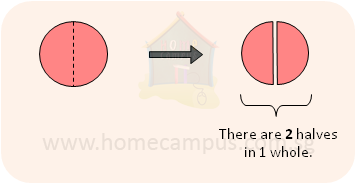
1 ÷
| 1 |
| 2 |
You get 2 slices.
2. If 1 whole pizza is cut into one-thirds, how many slices do you get?
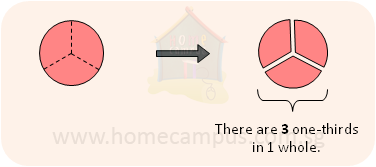
1 ÷
| 1 |
| 3 |
You get 3 slices.
3. If 2 pizzas are cut into two-thirds, how many slices do you get?
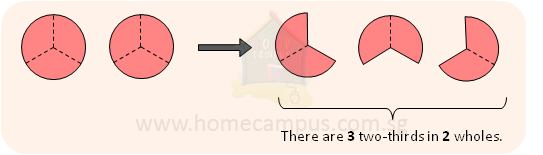
2 ÷
| 2 |
| 3 |
Cut both pizzas into thirds: 2 × 3 = 6 thirds. Each slice is 2 thirds, so put the thirds in twos: 6 ÷ 2 = 3.
That is the same as 2 ×
| 3 |
| 2 |
| 2 |
| 3 |
| 3 |
| 2 |
You get 3 slices.
4. How many two-thirds are there in 3 wholes?
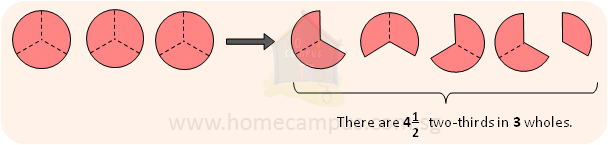
3 ÷
| 2 |
| 3 |
| 3 |
| 2 |
| 9 |
| 2 |
| 4 | 1 |
| 2 |
Cut 3 wholes into thirds: 9 thirds. Put them in twos: 4 groups, and 1 third left over. The third left over is half of a group of 2 thirds, so there are
| 4 | 1 |
| 2 |
There are
| 4 | 1 |
| 2 |
5. Nina had 2 m of lace that she used for making bows.
If she needed
| 2 |
| 7 |
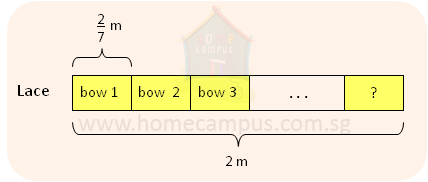
2 ÷
| 2 |
| 7 |
= 2 ×
| 7 |
| 2 |
= 7
She made 7 bows.
6. Mr. Lee buys 25 kg of decorative shells from a wholesale market.
He then repacks the shells into small bags of
| 1 |
| 4 |
a) How many bags does he get?
b) If he sells each bag at $3.50, how much money does he collect from the sale of all bags?
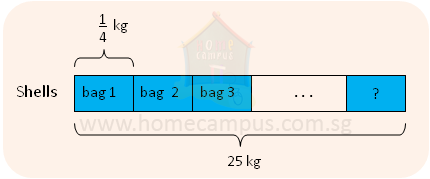
a) 25 ÷
| 1 |
| 4 |
= 25 ×
| 4 |
| 1 |
= 100
He gets 100 bags.
b) $3.50 × 100 = $350
He collects $350.
7. A chemist fills 5 litres of perfume into bottles that have a capacity of
| 2 |
| 11 |
a) What is the greatest number of bottles that he can fill completely?
b) In the end, there is one bottle that is not completely filled. How much perfume does that bottle contain?
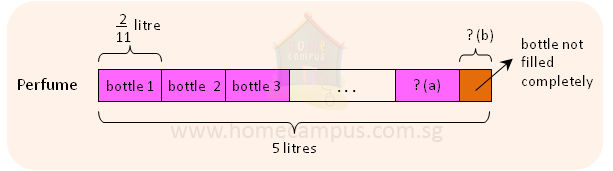
a) 5 ÷
| 2 |
| 11 |
= 5 ×
| 11 |
| 2 |
=
| 27 | 1 |
| 2 |
He can fill 27 bottles completely.
b) 27 ×
| 2 |
| 11 |
| 54 |
| 11 |
There are
| 54 |
| 11 |
5 −
| 54 |
| 11 |
=
| 55 - 54 |
| 11 |
=
| 1 |
| 11 |
The bottle contains
| 1 |
| 11 |